Showing posts with label Deltadactylia. Show all posts

Thursday, 19 September 2024

Awbar

When people think of extinct life, they usually have images of fossils and artistic reconstructions in their head. Extinction is a phenomenon seemingly relegated to the far past, to dinosaurs and mammoths. In reality, extinction happens all the time, throughout the present. It is a process as natural as life and death itself. Yet, it leaves us mourning when it happens in front of our own eyes.

The awbar were a fascinating species which the first astronauts encountered on Mars, including myself on some of my early missions. They lived in a peculiar area of the Argyre Basin. Mars lacks a global magnetic field like Earth does, making it an all-around more irradiated and hostile place. However, some areas contain highly magnetized rock formations, which have managed to save some remnants of the prehistoric magnetosphere, creating local shields against UV and other harmful radiation from space. In these so-called UV-oases, flora and fauna can lead a more sheltered life and attain higher biodiversity than in other areas of the planet. The awbar lived in one such oasis - only one – together with the organisms it depended on.

The awbar is thought to have been a goniopod, a group of dinosauresque deltadactylians, but unlike its bigger cousins, the cecrops and syncarpus, it was generally not included within the more exclusive Thecocerata, as it lacked the characteristic hornlets inside of its beak. This decision has often been criticized, as the lack of that trait may instead have resulted from its specialized diet. Other unique traits were that it felt comfortable walking both on two and three legs and that it exhibited multioculy (having more than two eyes), a trait otherwise rare in goniopods.

It was a nimble creature, able to fit inside a human hand. From its back grew a fleshy fin, adorned with a peculiar oval spot. Undoubtedly this served some display function, but what exactly is now forever uncertain. Awbar lived in close association with a plant dubbed the sporangobush, a type of fractarian. Its sporangia ended in hairy bulbs, each hair drenched in some kind of viscous liquid. Awbar were most often seen climbing up the bushes and licking these furballs with their long, retractable tongue. Many authors have assumed that this could have been a symbiotic relationship. Assuming the liquid produced by the sporangia was some kind of nectar, the Martian may have been lured into licking up the plant’s spores. Inside the stomach and guts of the creature, these spores may have combined with those of other sporangobushes and exited the body through excretion, already fertilized. It is impossible to test any such hypotheses anymore, however. There may not have been a mutual benefit at all to such behaviour, the creature could have been licking the sporangia for reasons entirely unintended by the plant. Perhaps the liquid was toxic or unappealing to some herbivores but was unintentionally alluring to the little creature, the same way spicy plants on Earth have unintentionally garnered the attention of humans. Or the relationship between the organisms was much more intricate and complicated than we can ever imagine, seeing as how little we still know about these ecosystems.

The extinction of the awbar was not brought about by a catastrophe like the dinosaurs’ or through human interference like the dodo’s. It was the end of a slow process already well on its way long before man set his foot on the red planet. The magnetization held within the surrounding rocks had simply begun to fade. With each passing year, the local magnetosphere grew weaker and more radiation reached the soil. The changes must have been incremental at first. With each blooming, the number in each organism’s generations must have grown less, rates of cancer and other ailments must have risen and gradually lowered their lifespan. The margins and tall hills of the oasis became barren first, the eggs of the sporangobushes and tube-cycads in the soil simply failing to germinate. These blank spots were then quickly colonized by more UV-resistant flora and planimals from outside the region, like chiropedes and the aggressive red weed. From that point on, the collapse of the previous ecosystem progressed at a geometric rate, as now the local organisms did not only face environmental degradation but also competition from outsiders they would have normally been able to outbreed. Local nekhbets failed to spawn and were gradually replaced by wadjets and more delicate spongisporians died from mutations before they could bloom, losing ground to their thorny upland counterparts. The ecosystem transformed and many were simply not able to adapt quickly enough to the changes. It was a prolonged evolution of the landscape, observed by us humans over a span of about twenty years. When the shield was finally gone, very little remained of the previous ecosystem. The last sporangobushes failed to reproduce and aged into misshapen mutants before mercifully fading away. The last awbar was already sighted five years before their extinction.

It is a curious feeling, to know that these little creatures used to crawl over my feet one day and are now forever gone. Though less spectacular than the great fossils dug out from the ground, their loss is a much more personal one. A more painful one. It is the difference between reading about Abraham Lincoln’s assassination in a schoolbook and seeing your own father pass away at the hospital. The many questions you ask yourself. Was this inevitable? Were there ways I could have helped? Why didn’t I try to help? Why did I not do more with the time we were given together? But such things, speculating about changing a past that can no longer be changed, hypothetical realities, is a futile misery. There was nothing I could have done. The magnetized rocks would have faded regardless of me being there or not and none of our expeditions were ever equipped to preserve species. We were just there to observe and study. And by the point I knew my father was sick, it was already too late for us to bond in the way be both wished we would have. Years of neglect had eroded any emotional foundation that could have been built upon. He was my father, and a good one at that, but he was never my friend.

Monday, 1 April 2024

Perchloraven

The toxic salt deserts of Mars are not home to many animals, most of them being small-to-microscopic extremophiles. But some creatures have learned to exploit the hostile landscape. In the northern hemisphere we have already encountered the caraxor, a flying pedicambulate which rules alone over the perchlorate wastes there.

In the wastes which pepper the highlands and tundra of the southern hemisphere can be found an organism roughly equivalent in ecology but highly aberrant in every other aspect, appearing like the Martian parody of a flamingo. The perchloraven is a member of the rare and elusive Monopoda, which are secondarily flightless ballousaurs. For whatever reason, their wings (former hindlegs) have atrophied. In some of the more archaic members they can still be used for gliding, whereas in more derived members like the perchloraven they can only be used anymore for social displays and balancing. This leaves only their single front-leg (formerly an arm) as an organ for locomotion.

This anatomy is obviously quite awkward and fragile, which makes it perhaps no wonder why these organisms are rare and only found in environments that lack competition or predators. The perchlorate deserts are obviously just such a place. Surrounded by kilometres of toxic plains and dust, the thermally heated brine pools which the perchloraven inhabits are isolated from the rest of Mars almost perfectly. Here it can awkwardly hop and shuffle around on its leg without fearing any danger.

Much like the caraxor, it can survive here thanks to a high resistance to saltwater and even perchlorate itself, having six nephridia (equivalent to kidneys) instead of the standard four that most other deltadactylians have, a genuine atavism it shares with more archaic onychognaths. Another surprising adaptation revealed by dissection is that the dark dots which colour its back and wings are actually caused by unicellular proteroareozoans which endosymbiotically live inside the organism’s skin. Highly infused with melanin, these microbes show signs of being radiotrophic, much like the fungi discovered in Chernobyl, being able to absorb and use cosmic rays and perhaps even ultraviolet radiation in order to metabolize. If this symbiosis simply exists to protect the perchloraven from the radiation it experiences at higher elevations or if it also gains energy from this relationship is not known. Some of these organisms can be found freely swimming inside the brine pools, so it is likely that the animal acquires them though its diet.

The perchloraven’s main method of feeding, filtering the briny water for small organisms, is evident by the long baleen-like bristles which grow out of its lower jaw, like the teeth of the bizarre pterosaur Pterodaustro. What the headcrest and attached skinflap are for is less obvious, though it likely serves as some form of social display. Perchloravens mate in pairs and give birth to live young raised in rocky nests. An advantage they have over their aerial cousins is that the loss of flight has made the pelvis much less rigid and narrow, allowing the chicks to be born much better developed. Usually they are able to stand, hop and feed by themselves a day or so after birth.

Why exactly the perchloraven is completely naked instead of having feather-scales like its relatives is a good question. Mainly living in thermally heated pools, it seems like there was no need anymore for insolation, allowing the organism to revert back to a more ectothermic metabolism in order to save energy.

On a zoogeographical note, it is also interesting that there is such a north-south divide between perchloraven and caraxor habitats. It has been proposed that the shrubland habitats which line the equator may prevent either organism from crossing into the other hemisphere, as they cannot feed in these zones and would also have to face predators which they have no natural defence against (Watzlawick 2114). What speaks against this is of course the fact that the caraxor can fly.

References:

  • Watzlawick, Paul: Wide-scale niche partitioning across Mars, in: Journal of Xenobiology, 189, 2114, p. 310 – 377.

Tuesday, 23 May 2023

Djihauti

The Djihauti is an organism that is perhaps best described as an animal that does not seem comfortable in its own body. Despite a somewhat antelope-like appearance, it has neither the style, nor the grace (though it has a funny face). When it walks, it seems like the single, huge frontleg is simply way too long for its hindlegs to catch up, leading to an awkward gait where the organism can seemingly only move by slowly inching its way forward. Instead of a gracile ungulate, its methodical, tank-like movements remind one more of a crab than anything else. 

Catching a djihauti then, whether you be a predator or naturalist, would then seem like an easy task. Just grab it by the neck like a duck and walk off with it. But in reality you would be eating dust before you even laid a single finger on it. Everything about Mars is deceptive, including its wildlife. Djihauti is the embodiment of Sun Tzu’s maxim of needing to appear weak when you are strong and its strengths are only revealed through careful observation. Marvel at its extraordinarily long neck, with which it gazes high above the savannah vegetation. Its double head-crest is studded with multiple eyes on both sides, which are asynchronously replaced one at a time, so that it never loses its large field of vision. Its large antennae can pick up even minor smells and vibrations in the air. This creature can sense you coming long before you are even aware of its presence. 

And when you do manage to sneak up on it, it will pull its greatest trick. The long forelimb, which at first glance seemed like a liability, will suddenly catapult the whole creature high up and far into the air like a vaulting pole. The hindlegs will catch it again on the ground and the creature will continue bounding forward with all three limbs like a mad mix of rabbit and pogo-stick.

When not concerned with evading predators, djihauti lead rather unassuming lives. Inhabiting the Hellas savannah, they largely feed on tall-growing vegetation, such as scale-tree-needles, which they strip off with their beak-like jaw. Between the jaw-joint and the eye-prongs, the skull is strangely elongated and dissection has revealed that inside this tube-like part lies a rasping tongue which apparently helps grind up the food against a roughened palate. Unlike some of their extinct relatives, all modern onychognaths lack true teeth, so this arrangement seems to have evolved as a replacement for molars. After the grind, the bolus is swallowed and digested in the large gut which gives this animal such a barrel-chested appearance.

Djihauti are gregarious and seem to have evolved various forms of visual communication. Most obvious is the stretch of skin that spans between the two eye-crests. They are able to change its colour from a mild blue to a deep violet, though the exact meaning of this signal is so far unknown. When in groups, djihauti rotate their head a lot, like flagposts, which may be a way for them to better flaunt their skull-sail. Also prominent are the long, ribbon-like scales which grow off the animal's back almost like a feather-wheel. Although a role in thermoregulation has been proposed, most  signs point towards it being a pure display feature used during mating. 
Djihauti like associating with ushabtis, often browsing together. Ushabtis are much taller than djihautis and therefore even better at spotting dangers at far-out distances, so this relationship likely evolved as a form of protection. Ushabtis can also reach into taller canopies and the tripods like feeding on the debris that falls onto the ground when the bipeds rip out leaves and branches from trees. Djihauti can in turn emit a loud warning call with their spiracles when sensing danger, so the benefits from this relationship may be mutual. On the other hand, ushabtis do not seem to care much about their neighbours' wellbeing. Juvenile ushabtis can sometimes be observed using djihauti as "playthings", violently kicking and tossing them around with no warning or just generally bullying them. It is possible that this behaviour is caused by hormonal changes in the youngsters that lead to aggressive behaviour that needs to be vented. Djihauti in turn have no qualms about scavenging the corpses of dead ushabtis (or other animals in general), despite being herbivores. One has to make use of every resource available if one is to survive on this and other worlds.

Saturday, 1 April 2023

Snickers

Infamous is today the 24th and 1/2 century for its great shortage of the element illudium phosdax, which was in fact a major driver in the exploration and colonization of Mars by the inhabitants of Earth. Early on, satellites had detected a great abundance of the element embedded in the surface of the planet, with the highest concentrations being found in the lush rainforests of the Argyre Basin. Isn’t that lovely?

The first to explore these uncharted forests was the astronaut D. Dodgers, where he made contact with the snickers (Lunitunus ridiculus), a diminutive species of ushabti. Like its larger relatives, it walks on two upright legs and has a single arm, though there are many things which set it apart. First there are the large fans of feather-scales, which form a sort of flowery “skirt” around the hip area. One presumes that this is a sort of display feature. Then there is the head, which is rather unique among the onychognaths. Mostly spherical in shape, its bony rims and brows give the appearance of a helmet. The mouth underneath the two large eyes is small and the same colour as the face, making it almost invisible. As in its larger relatives, its antennae are on top of the head, but uniquely aligned in a central line, their ends forming a bristle.

Dodgers’ first encounter with these aliens was unplanned and greatly hindered him at discovering an access to the illudium phosdax hotspots. At first, the creatures were simply curious, being for some reason greatly interested in his shoes. But then Dodgers, greatly annoyed, kicked one of the creatures, which made them very angry. Very angry indeed! A whole host of snickers descended upon Dodgers, who was unable to defend himself, as his disintegrating pistol had earlier disintegrated itself. Dodgers had no choice but to retreat back to his vehicle, where the escape was further halted by a malfunction of the ship’s AI. Oh drat, these computers! They are so naughty and complex; I could pinch them.

Dodgers gave his space-mining administration the recommendation to neutralise the site for easier access by utilizing an Illudium Pu-36 Explosive Space Modulator, but this was rejected as the force of such a weapon would surely result in a mars-shattering kaboom. However, we Kaldanes, now that we have infiltrated the humans’ bases and expunged them from our home, have taken a great liking to Dodgers’ suggestion, though we would rather prefer administering the Illudium Pu-36 Explosive Space Modulator with Earth as a target. It has been obstructing our view of lovely Venus for far too long now.

Wednesday, 25 January 2023

Great Ushabti

I doubt if they even have a real language – all the talk about psychological communication through those tentacles on their chest strikes me as bunk. What misleads people is their upright posture, just an accidental physical resemblance to terrestrial man.

- In the Walls of Eryx, Howard Phillips Lovecraft

Ushabtis are a group of deltadactylians found across Mars, but their most famous member, the great ushabti, is only found in the Hellas Savannah. While the almond-shaped head, the antennae, the dark tuquoise skin colour, the single arm growing from the centre of the chest and the two-toed feet are clearly inhuman, these animals have always captured our imagination due to their upright, bipedal gait, which happens to parallel our bauplan so closely that these creatures even possess recognizable buttocks. When astronauts first encountered the ushabtis, they initially believed to have finally found the legendary Martians, the intelligent beings of folklore who built the infamous canals. Further observation quickly broke that illusion.

Ushabtis do not live in houses, they do not wear clothing and they use neither tools nor fire. They sleep in the open, cowering in fear of the savannah’s predators, and do not mourn their dead. Their corpses are left behind for the scavengers to feed on. They roam the plains in herds and feed on tall-growing plants using their long arm, spending most of the day either eating or sleeping. They do not process their tough, coniferoid food, they simply swallow it whole through their delicate beak and, like ostriches, let gastroliths do most of the work. Problems within the herd are solved either through head-bashing or fist-fights, sometimes to the death. Ushabtis are just beasts of the field, as intelligent as deer, in my opinion. They approach the human condition about as well as penguins.

And yet, some researchers claim to have observed at least glimmers of social intelligence. Great ushabtis, like most deltadactylians, give live birth (which, combined with the bipedal gait, may explain the human-like, “feminine” hips) and while the young come into the world developed well enough to walk shortly after, they are still greatly cared for by the rest of the herd, hinting at strong familial bonds. The communication among herd members has also frequently come under scrutiny. Like most onychognaths, they can produce chirps or stereo whistles through the spiracles above their collarbone or on their abdomen, but these are quite simple. More interesting is what ushabtis do with their single hand. Like its human counterpart, it is a very flexible organ, able to articulate in both directions at the wrist, with the four fingers being very dextrous and muscular. While it is mostly used for grabbing and drawing near the branches of fractarian trees, when in groups, the ushabtis have been observed contorting their fingers into odd gestures without clear function. Some have speculated that this may be a form of sign language, but if this is true, nobody has been able to decipher it yet. Most of the gestures are seemingly random and there are only very few that could be called distinctive signs. Amusingly, one of these identified signs is one wherein the ushabtis press one of the lower fingers between the other three. American astronauts have likened this to the “got-your-nose” gesture, whereas Soviet cosmonauts have compared it to the Eastern European fig sign. When ushabtis show this to each other, it is often followed by aggressive behaviour, but sometimes also playfulness. The position of the antennae, which, rare for most onychognaths, are placed at the very back of the skull, may also have meaning in some contexts, similar to how mammals show emotion through ear positions.

Interactions between humans and ushabtis are of an uneasy nature. For the most part, ushabtis are fearful of us, which makes sense, as we are completely foreign organisms. Sometimes, however, they may show curiosity and cautiously approach us. Perhaps, like penguins in the Antarctic, they see a bit of themselves in us due to our shared upright gait. Closely interacting with ushabtis is not recommended for any personnel. While they may look friendly or even playful, they are the only species on Mars that can exceed an average human in height and can therefore pose actual physical danger. Their large hands can be clenched into a fist that can actually pack a punch that hurts. As with Cecrops, their simple curiosity may also kill some cats. My colleague Jim of the Horus-23 was once approached by one overly curious individual, which, while not showing any signs of aggression, suddenly enveloped his whole helmet with its large, muscular hand and gently pulled on it, as if trying to take it off. Thankfully, Jim was able to resolve the situation without anyone getting hurt once the ushabti lost interest.

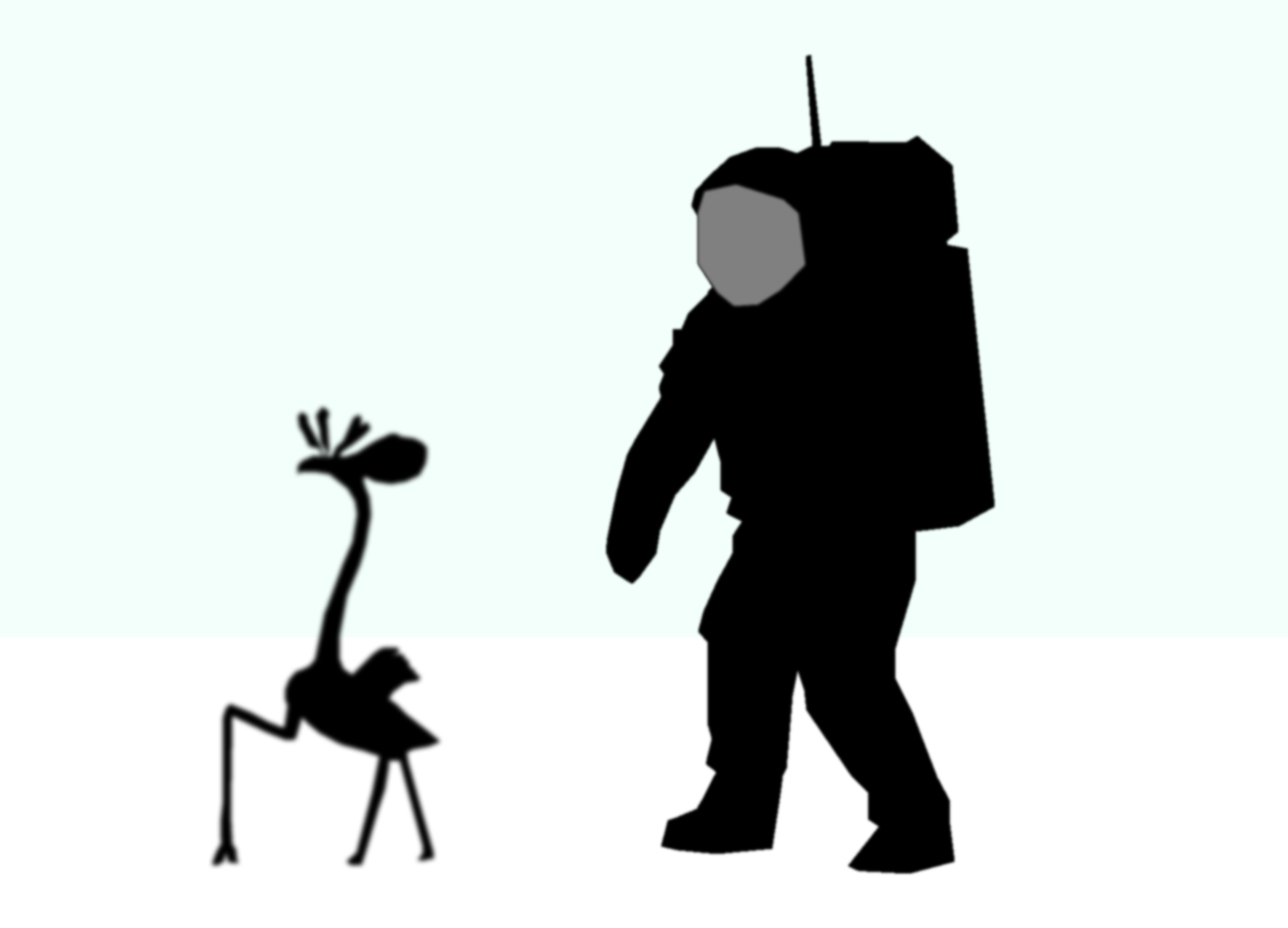
 Size comparison between Man and Martian

The phylogenetic placement of the ushabtis within Deltadactylia is so far unresolved. Until recently, due to their bipedal gait, they had been grouped among the Goniopoda, however, most known goniopods possess tails and walk on digitigrade feet with simple hinge-like ankle-joints. Ushabtis meanwhile walk on plantigrade feet with a more crurotarsal ankle. It seems far more likely that they represent a separate experiment in bipedalism among the deltadactylians. Possibly, their ancestor was a long-legged tripod browser with an already reduced tail that, like the gerenuk of Africa or ancient anoplotheres, regularly reared up onto its hindlegs to reach higher tree branches. Instead of evolving longer legs or a longer neck, evolution then drove these animals towards dedicated bipedalism. In that sense they may be the Martian analogue to the extinct sthenurine kangaroos, who are theorized to have also evolved a humanoid gait and buttocks. What this does not explain is the odd skeleton of the ushabtis. While all onychognaths use some degree of biosilicon in their body, especially for their solid eyes, ushabtis are unique for having a large part of their internal skeleton made of silicon dioxide, almost like a glass sponge. If these beings were ever brought to Earth, the mere attempt of standing upright may crush every bone in their body due to our home’s great gravity.

Ushabtis have had a great influence on Earth’s pop culture. Especially the very first reports made by astronauts about these supposedly being the Martians everyone was looking for, combined with some early speculations about language and culture, gave many people the mistaken impression that these were sapient beings. Consequently, the markets were flooded with books, comics, movies and videogames wherein ushabtis are depicted as tribal people defending their home against evil Soviet or Chinese spacefarers (a few stories do exist where American astronauts are the villains, but these have been censored until recently). In most of these, the ushabtis’ cultures are depicted as stereotypical, culturally insensitive pastiches of Native Americans or Islamic people (perhaps due to Mars’ reputation as a desert planet, although most of the surface is actually tundra and ice). The most egregious among the latter is the popular Dunes of Mars series by author Hank Sherbert. His ushabtis are depicted as desert nomads clothed in veils, with cultural practices that mirror a weird mix of Arabic, Jewish and Iranian elements. They possess a superstitious and irrational psychology, a corrupt, despotic rulership, a legal system based on trial by combat, trade an opium-like substance and are in a state of holy war against the local Soviet space colonies. They also worship and ride great “sandcrawlers”, a wholly fictional creature seemingly created to be the biological equivalent to a flying carpet. Their white saviour, who is of course an American astronaut, is obviously modelled after Thomas Edward Lawrence. I wonder if Edward Said would call this space orientalism if he were still alive.

More recent stories have acknowledged the true animalistic nature of the ushabtis, but adapt the pseudoscientific idea that they are the devolved descendants of a former Martian civilization. Most of these stories are moralistic author tracts about the "degeneration" of society and culture and what they think will cause the downfall of civilization. An infamous example is the novel Red Dusk by Michael Crichton, in which the Martian civilization collapsed due to environmental conspiracies, reflecting the author's own notorious scepticism of climate science and his rather loose adherence to facts.

An unfortunate byproduct of many ushabti stories is the bizarre sexualisation of the organisms, despite appearing inhuman anywhere except the pelvic region. This is especially common in media from East Asia and Europe, but there are also homegrown examples, like an episode of Star Trek where Captain Pike has an affair with an actress dressed in an obviously inaccurate ushabti costume made to show off her décolletage. Most infamous is however the fact that the last artwork ever created by the late C.M. Kosemen was an unfinished series of paintings wherein ushabtis are depicted engaging in all sorts of gigeresque acts of copulation. Kosemen had previously commented that, to primitive-minded men, ushabtis are the ideal woman, for they have the lower half of one but none of the intelligence above. What he and many others apparently failed to realize is that ushabtis, like nearly all animals on Mars, are hermaphrodites. While their vertical cloaca does have a vaguely vulvaic appearance, if one madman were to “probe” further inside, he would be in for a grave surprise.

As awareness of the actual scientific truth of Mars is growing in the general public, most of these tropes are thankfully fading away from pop culture. When it comes to children’s media, however, the trope of the intelligent ushabti is still popular. My own son was a big fan of such a cartoon show and asked me how it was meeting the Martians. I indeed had met ushabtis up close on one of my last missions, though it did not amount to much. It would have broken his heart if I told him that the Martians he knew from his action figure adventures were no smarter than sheep, so I obviously made up a bedtime story instead. The Martians invited use to their home, we had tea and cake, tried out an anti-gravity trampoline, they helped us repair our avrocar and together we fought off an attack by another group of evil aliens. John Carter was there too, in some versions. My boy is now an adult and obviously does not believe my stories anymore, but I made a pleasant discovery last Christmas. After I gifted my grandson as set of Martian and astronaut minifigures from some Danish brick company, I observed him using them to play out the exact same tall tale I had years ago told his father. This being my legacy is all I need to be happy.

Please consider supporting me on Patreon to get a look at WIPs