If one had to accurately describe Robinson Crusoe
on Mars, one would not have to look farther than the movie’s title, as it
is pretty much exactly what it says. But if one had to describe it in another
way to modern audiences, it is basically The Martian by Andy Weir, but
released eight years before Weir was even born. Coming out in 1964, the movie
tells the story of an astronaut stranded (nearly) alone on Mars and trying to
fight for survival. Being made before the likes of 2001: A Space Odyssey or
Planet of the Apes, one would expect
this to be a typical science fiction movie of the era, with all the campiness
that comes with it, from bad acting and lousy effects to concepts and creatures
that are more fantastical than they are scientific. But, while there are traces
of camp here and there, Robinson Crusoe
on Mars, made by Byron Haskin, best known for 1953’s The War of the Worlds, decidedly stands out, as
it is a genuine attempt at classic science fiction and was made at a crossroads
between our old and new understanding of Mars. As such, it is of historic
importance, as a real attempt was made to capture the then current vision of
the surface conditions of the red planet. Don’t believe me? They even went as far as
putting the label “This film is scientifically authentic” on the poster. Is
that not hilariously fantastic? More movies should have that. What if we started
putting labels of scientific accuracy on sci-fi media, complete with a rating
system?
The Story
The movie begins
with a manned mission in the orbit of Mars. On board are the two astronauts,
Christopher Draper, played by Paul Mantee, and Dan McReady, played by Adam West
(yes, THE Adam West. Batman is in this movie, deal with it), as well as their pet
companion, a spider monkey named Mona (female in the movie, but according to IMDb played by a male monkey, who had to wear fur pants to hide that fact). As they
orbit, they come too close into contact with a meteoroid and have to abandon
the main ship by separately entering the escape pods to land on the planet.
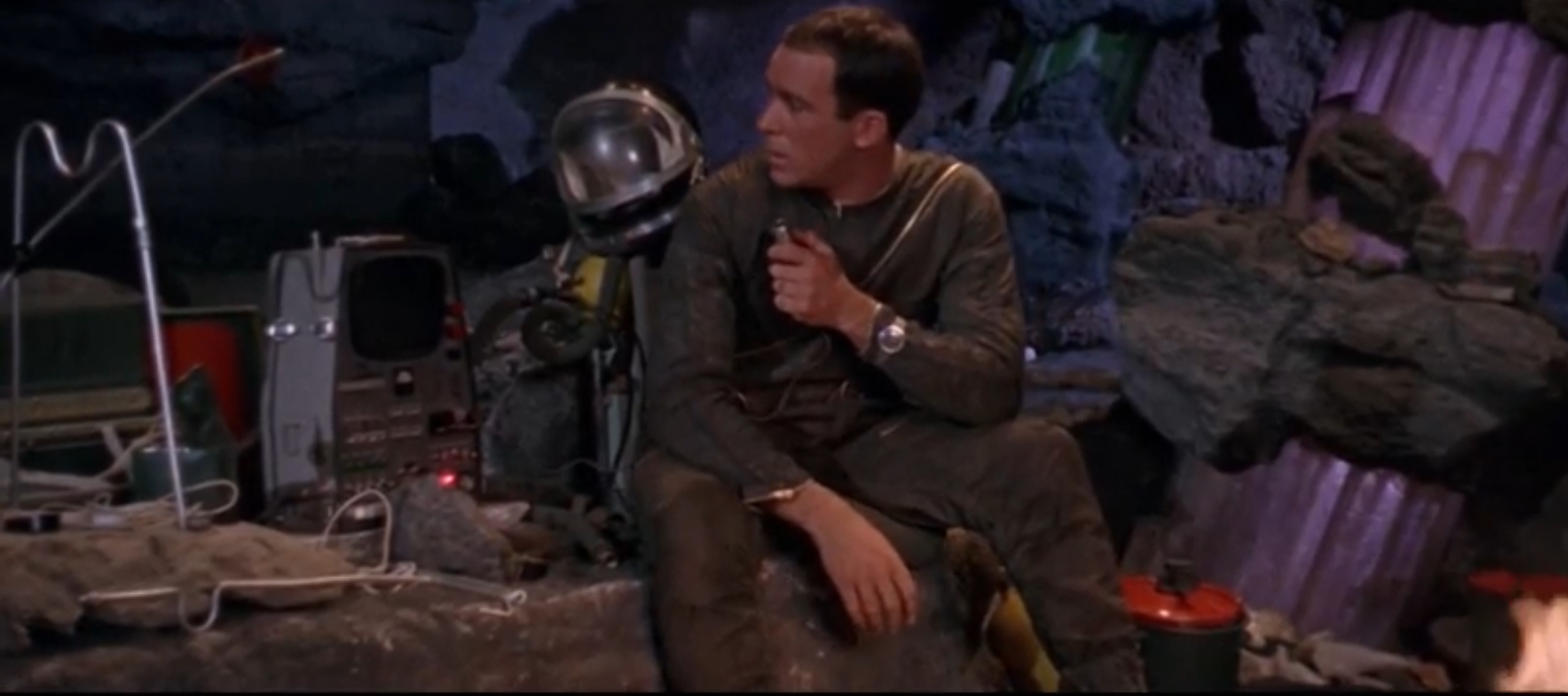
There, Draper crash-lands
alone, completely wrecking his vessel but surviving. The surface of Mars is arid,
cold, no vegetation or life in sight. Though the air pressure is still high
enough and there are low amounts of oxygen, so that Draper can take off his
helmet and survive for about thirteen minutes before he has to return to breathing
with his air tanks. This is obviously where the movie differs from modern
knowledge, but it was very accurate to how surface conditions were envisioned in
the early 60s. Earth-based telescopes and spectroscopy had already advanced
enough by then to determine that Mars was not hospitable enough to support the
civilizations and fantastic fauna of older fiction, but without direct measurements
taken, it was still thought that the air pressure was high enough (in part because the dust veil around the planet gave astronomers the impression of a thicker atmosphere), perhaps
similar to that around high mountaintops on Earth, that simple life was
possible on the surface and that human astronauts might only need breathing
masks. That Draper can breathe for a few minutes without tanks also seems plausible with then current knowledge, as seasonally changing colour-patches on the surface (not seen in the movie, but referenced at one point) were interpreted as vegetation and where there are plants there might also be a bit of oxygen. Only a year after this movie was released would Mariner-4 fly by Mars and show that even
this scenario was too optimistic.

After Draper
salvages what he can, he makes his way across the lonely dunes and hills of
Mars, finding shelter in a cave. Most of the movie was shot in Death Valley,
but smartly, the blue sky of Earth and other background shots were replaced
with matte paintings by Albert Whitlock (who would later also work on Star Trek and Carpenter’s The Thing), which
give the movie an appropriate and rather beautiful alien atmosphere. Some shots
even look remarkably similar to real life photos that would later be returned
by the Mars rovers. The following days, as he uses up his air supply, Draper
tries to find his friend McReady again, but is devastated to see that he has not only also crashed but died in the process. Only Mona the monkey survived. Together
they go back to Draper’s cave, where he knows that the dwindling air supply
spells doom. Nearly suffocating to death, he then finds out by accident that the
strange yellow rocks he as been finding across the Martian surface are
flammable and, when burned, actually release oxygen for him to breathe, saving
his life. While this was obviously a convenient invention by the movie, there ironically
is now some basis in reality to this. Today we know that the Martian sands are laden
with perchlorate salts. Though toxic to humans and white in colour, with the
right chemical reaction these can actually produce free oxygen. Various microorganisms
on Earth, such as bacteria of the phylum Pseudomonadota, make use of this
reaction, which obviously inspired my own
work here on this site.


From here on out the
movie follows the classic robinsonade-style story, just in its Martian setting.
Having found a temporary solution to his oxygen-problem, as well as fuel for a
nightly fire to keep themselves warm, Draper and Mona now have to contend with
the lack of water and food, as supplies are quickly running out. In a cave they
find a subterranean aquifer, in whose waters grow alien plants, looking like a
mix between reeds and sausages. These the two are able to cook and eat. Using
the newly-found resources, Draper builds himself a little farm and with the remaining
scrap metal constructs various conveniences and contraptions to turn his shelter into a home, morphing from astronaut back into caveman in the process.

But the worries do
not end. While the movie does give its characters occasional breaks from the
distressing situation they have found themselves in, it does nonetheless take
itself very seriously. The monkey is surprisingly almost never used for comedic
relief, but acts more as both a consolation as well as frustration for Draper. Though
she gives him someone to care for, he cannot hold a conversation with her,
which he obviously laments as the many months of isolation wear on.
Heartbreaking, and quite well-acted by Mantee, is also a dream sequence where
Draper sees his friend McReady alive again, but unable to talk to him, taunting
his loneliness and driving him to near madness. Here the movie is very close
again to the realities of space travel, as the consequences of the long periods
of isolation that come with it will inevitably have negative effects on the
human mind. This is a problem any modern prospect of a manned Mars mission will
continue to struggle with.

From here on out we
go into spoilery territory (so read at your own caution), but you could have
probably already guessed by the poster that Draper is not as alone on Mars as
he had thought. While there are no native Martians and the movie even goes out
of its way to explain the infamous canals as natural volcanic features, Draper
eventually comes across a mining colony set up by aliens from another star
system. Said aliens are quite evil and use slaves for labour. While spying on
them, Draper bumps into one of the slaves, whom he calls Friday, in direct
reference to the equivalent character from the Daniel Defoe novel. Friday is played
by Victor Lundin, who would later go on to play the first onscreen Klingon in Star
Trek, and looks exactly like a human. The alien language he speaks apparently
also consists of Mayan words, which is perhaps some stealth reference to
ancient astronaut hypotheses. In my personal head-canon, Friday is not an alien,
but instead a descendant of ancient Mayans who were abducted and enslaved by aliens in antiquity.
His relationship with Draper, as they flee together and hide at his shelter, is
an uneasy one at first, but they get to know each other and become friends,
with Draper attempting to teach Friday English. Eventually, however, their
hideout is found by the slavers and they have to flee. What happens from
thereon after I let you find out yourself.
Why you should watch
it
Robinson Crusoe on
Mars is many things. First, it is a quite good adaptation that perfectly captures
what made the original Defoe novel appealing and also elevates its elements thanks to its higher stakes setting. Dare I say, it even improves upon it. Astronaut Christopher Draper certainly is a more likeable and relatable character than
literal slave-owner/trader Robinson Crusoe. Draper’s respectful conversation with
Friday about what God means to them will also likely resonate better with
modern audiences than Crusoe’s blunt conversion of Friday to Christianity.
Also, it is an “X in space” adaptation, which immediately makes everything
better.

Secondly, it is
science fiction of the best kind. It took what was known about Mars and
spaceflight at the time, extrapolated it to create an interesting setting, took
only few artistic liberties and put the protagonists against the thus
generated odds, while also not being above having fun with its setting. While the
movie was made right during the transition from old to new Mars, it also feels
like a missing link between older and newer sci-fi movies. While the second
half of the movie, with Draper and Friday escaping the alien slavers, still has
clear shades of campy B-movies from the 50s, the first half has a serious, suspenseful,
tough scientific feel that foreshadows examples of the genre that would
come later, such as 2001, Star Trek
or Alien. In a few ways it
even already pokes fun at things that would become tropes in the future, such as when
Draper theorizes that Friday communicates telepathically, to then discover that
the guy can just talk and was simply acting mute at first. One could almost
think that is a jab at Star Trek type
aliens, if not for the fact that the original series would not come out until
two years after this movie.
Thirdly, it is just all-around
enjoyable to watch. The effects are decent for the time, the sets are beautifully
designed, the technological props have that lovely outdated haptic look with
buttons and tube-monitors (which still has lost none of its charm, as media
like Fallout proves), the music is atmospheric and triumphant and the
actors convey genuine emotion. I just said in the previous paragraph that the
second half of the movie is reminiscent of earlier B-movies, but this does not
at all mean that it brings the quality or seriousness of the movie down, for
the simple reason that the blooming friendship between Draper and Friday is a
heartfelt one that the viewer will love to watch and root for, as the two
strangers struggle together for survival against all odds. “Heartfelt” I feel
is the best way to describe this movie in general.
In conclusion, this
is exactly the kind of movie that makes young, impressionable children want to
be astronauts, just as Karel Zeman’s Journey to the Beginning of Time made kids in the 50s want to be
paleontologists. It portrays space as a dangerous place, but one that begs to
be explored and is filled with opportunities for adventure. It combines the
best elements of science fiction with those of a robinsonade: Man, faced against
strange new lands, creatures and technologies, survives, thrives and conquers
through his sheer ingenuity, curiosity and determination. Lastly, it shows that
even faced with the increasingly harsher reality of Mars, great stories can
still be told on the red planet. This is directly proven by Ridley Scott’s
2015 adaptation of The Martian, which
could be viewed as a modern up-to-date remake of Robinson Crusoe on Mars
and was a resounding financial success that won several awards. In this light,
let us pay some tribute to the movie that did it first and paved the way for
many later classics. Matt Damon also did not have a pet monkey in that movie,
which immediately makes it worse.
Oh yeah, and you can
also just watch the movie through the Internet Archive
If you liked this and other articles, please
consider supporting me on Patreon. I am thankful for any amount, even if it is
just 1$, as it will help me at dedicating more time to this blog and related
projects. Patrons also gain early access to the draft-versions of these posts and other exclusive contents.
Related
Posts: